Re: 100% homegrown

Wed Mar 14, 2012 12:28 pm

scotchpine wrote:Cool. Can ya grow that stuff on the moon, cause I think BMC needs a new gimmick: http://now.msn.com/money/0308-ice-tea-beer.aspx

I can't believe that iced tea stuff! Talk about something you could make better at home. It's like buying a pre-mixed margarita.

Accumulated GDD since emergence of the first leaf = 1093.

Most of the field is at awn emergence, right were Merit was around the same GDD:

Image

The most advanced part of the field seems to be in flowering, with most heads emerged or partially emerged, about a week ahead of Merit. This is the same trend that has existed going back to the first stages of leaf development.

Image

Even the short, nutrient-deficient part of the field has emerging awns:

Image

although, they are patchier there than in the healthy parts.

Anybody familiar enough with kernel development to know if this guy is past flowering and into the soft dough stage?

Image

I guess the main conclusion I have so far is that fertilization and perhaps planting rate have a drastic impact on plant development. We'll see if that carries over into the yield I can get from different parts of the field.

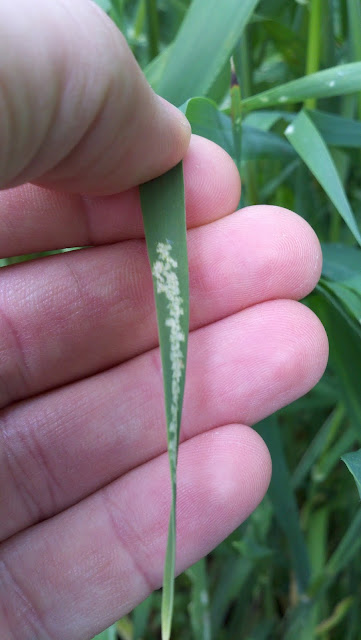
Also worth pointing out -- the field is crawling with aphids:

Image

They don't seem to have carried any viruses, but I would have liked to have sprayed with an insecticide early on. Still have the option, but navigating the field is so hard, that I imagine I would cause more damage to the plants than I would prevent. Any advice here?
User avatar
drummstikk
 
Posts: 68
Joined: Thu Feb 18, 2010 2:32 pm

Re: 100% homegrown

Thu Mar 15, 2012 5:35 am

Try a local Ag extension office. They might be able to help you out with finding/obtaining ladybugs or other pest control that is not an insecticide.
Fermenting: English Mild
Conditioning: Wild Pumpkin
Drinking: Funky Saison
User avatar
Cody
 
Posts: 267
Joined: Mon Feb 07, 2011 8:54 am
Location: MA

Re: 100% homegrown

Tue Mar 20, 2012 8:29 pm

Are these flowers?

Image

I also noticed a bunch of dust (pollen?) floating off of the heads when I shake them. I was under the impression that most barley lines are selfing, that they only mate with themselves because pollination occurs internally to each seed. There aren't any other barley crops near my field (the bere hasn't even headed yet), so I'm not worried about genetic contamination. But I'm just curious: is this a sign that Conlon barley is able to have sex?

In other news:

Image

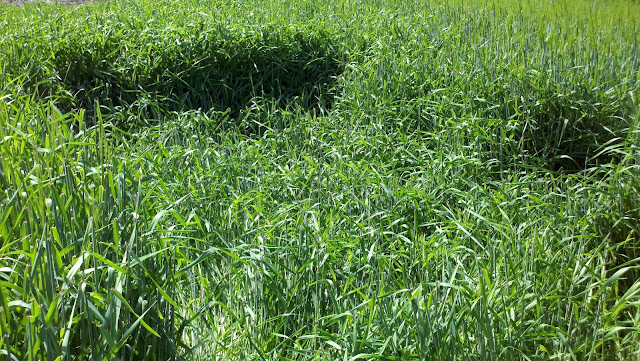
I have a crop circle! Actually, it's more of a blob. And even more actually, it's lodging. Lodging happens in varieties with plump grains when they get a little too much nutrition combined with some rain and wind. Last week we had half an inch of rain, which doesn't sound like too much, but apparently it was enough to do the trick.

Image

The plants are bent over at their 1st node, and they have begun to straighten up at the 3rd node. The overall effect is an S-shape in the stalk. Unfortunately, there doesn't seem to be much to be done once the crop is lodged. There will be some losses, but many of the plants will straighten out and produce grain:

Image

You can see the flag leaves and awns of the lodged plants still pointing skyward, albeit at a lower elevation.

Now check this out: the lodged area is right next to and has received the same amount of fertilizer as the area that is stumpy and yellow. I indicated the lodged area on this old photo:

Image

Lodging can be caused by several things, but it typically doesn't happen to undernourished crops. So what's going on?

I can't say I'm sure. It could be that nitrogen was distributed in a strange pattern in the soil from a previous crop. Or it could be that the stumpy crop and lodging both have something to do with water.

The lush crop that had a lodged section is located in an arc around an irrigation head. Maybe this head is usually providing plenty of water (too much last week), but the rest of plot 2 is underwatered. Now, I don't think the crop shows signs of water stress. I haven't seen any wilting. But as Fifelee on HBT suggested, it could be that the crop in this part of the field has short roots due to frequent but too light watering. Those short roots may have exhausted the nitrogen in the top layer of soil, and they may be unable to get to nitrogen in dry deeper layers.

It's just a guess -- I won't know the water depth for sure until I dig a hole. Any thoughts here are much appreciated, as always.

Well, though the patchy-ass nature of the field has thus become more patchy-ass, there is plenty of good news to be had in picture form:

Image

These grain heads are on the shortest, most nitrogen-deficient-looking plants in the whole field! Whatever the issue is, I'm still going to get some grain from this part.

Image

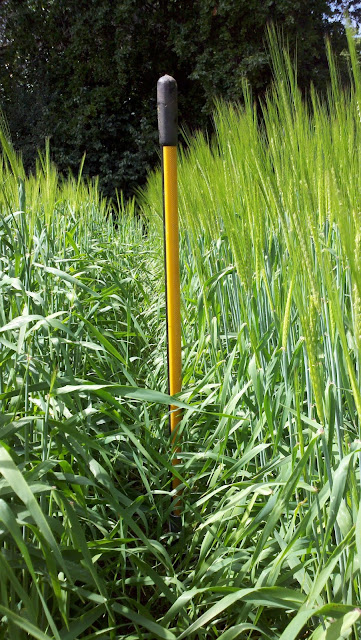
This shovel is about four feet tall, and awn tips in this part of the field are at nip height.

Image

A few of the bere plants are beginning to show their six-row heads, though most are just beginning to show emerging awns.

Image

Hmm, that looks like at least one 5-gallon keg full of beer. Must not get hopes up, must not get hopes up...
User avatar
drummstikk
 
Posts: 68
Joined: Thu Feb 18, 2010 2:32 pm

Re: 100% homegrown

Tue Mar 20, 2012 8:39 pm

Sweet! Glad to see you are getting some production for all your time and effort!
Spiderwrangler
PFC, Arachnid Deployment Division

In the cellar:
In the fermentor: Belgian Cider
In the works: Wooden Cider
User avatar
spiderwrangler
Global Moderator
 
Posts: 4659
Joined: Thu Jun 03, 2010 2:09 pm
Location: Ohio

Re: 100% homegrown

Tue Mar 27, 2012 12:17 am

Nothing to do now but wait for grain heads to fill.

Well, nothing to do except grow some hops! Over the past few months, working on the barley has been so new and different, that it was almost easy to forgot that I've only been working on 50% of my quest to make a 100% homegrown beer. (Well, 25% if you count homegrown water and yeast, but those parts are always homegrown, right?)

On to hops: I have 2-year-old vines of Columbus, Chinook, Glacier, and Cluster in my backyard, but I'm moving to another apartment. That means I have to transplant my hops if I want to take advantage of the growth in the root structure from last year. Even then it's hard to get all the smaller roots when you dig them up, but worth it. One positive aspect of the transplant is that this will be a great opportunity to plant them correctly in a permanent location on the farm, where even if I someday leave the Bay Area, another brave soul can take over the mature plants.

I got permission to plant hops along a south-facing chain link fence with access to drip irrigation.

Image

There are some oaks on the north side of the fence, but the southern view is all clear -- really, it doesn't get better than this unless you build your own hop trellis in the middle of an open field. You can see the black irrigation tubing snaking along in the foreground.

First step was to pick sites and dig holes, 1-2 cubic feet each, for four transplants and five rhizome cuttings from Freshops. I've heard they dig holes much deeper and bigger on a hop farm, like maybe 9 cubic feet, but I kept my holes on the smaller side because of the amount of work required to dig by hand. (Where has my work ethic gone since the days of digging furrows across the entire field? I don't even want to dig nine wimpy holes now!)

Image

Then fill up with compost

Image

The compost is so loose that it easily compresses into the bottom of the hole. When you fill in the original dirt, it just makes a small mound, which is what you want to prevent water from pooling near the crown.

Image

This transplanted Columbus plant has seen happier times.

Check out some of these rhizomes/roots of the 2nd year plants:

Image

You can see the original rhizome cutting in this Glacier plant's root structure.

And this cluster plant is an absolute beast:

Image

Transplanting ripped most of the smaller roots off of each plant, so I imagine the plants will grow slowly at first, sort of like a repeat of the first year.
User avatar
drummstikk
 
Posts: 68
Joined: Thu Feb 18, 2010 2:32 pm

Re: 100% homegrown

Tue Mar 27, 2012 4:07 pm

Alright then, nothing to do for the hops but wait a while. I could add some fertilizer, but I think they're still recovering from the shock of transplantation. Plus, there's rain this week, so I'll wait.

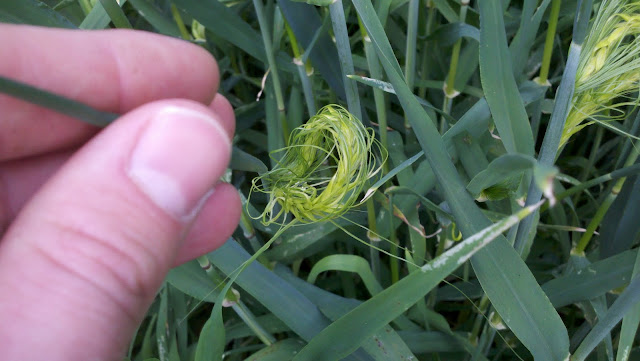
Back to barley! I have been noticing some strange flag leaves among the bere plants -- the leaf is all rolled up like an onion plant:

Image

In the affected plants, the heads have a hard time emerging from this funky rolled-up leaf:

Image

Image

I had no idea what to make of this, but today when I was doing some light reading on frost susceptability in barley, I ran across an image on page 11 of this document. The photo showing injury from phenoxy herbicides matches my rolled flag leaves and cramped head exactly. It turns out that phenoxy herbicides include 2,4-D, which I did apply to the bere back in December!

A little more reading revealed that injury from 2,4-D depends on the species of grain (and presumably even the variety), but commonly occurs in two time periods -- during the boot stage, which some of the bere are in now (I haven't applied any 2,4-D recently), and before tillering, a much earlier stage when side stems formed. I did apply 2,4-D right at the beginning of tillering!

I applied 2,4-D on 12/23/2011, at 190.5 GDD, when the bere plants looked about like this:

Image

Those are Conlon plants pictured, but according to my notes, the bere were at the same developmental stage -- very early tillering. I bet there were some bere plants that had not tillered yet, or that bere is simply more sensitive to 2,4-D injury than Conlon.

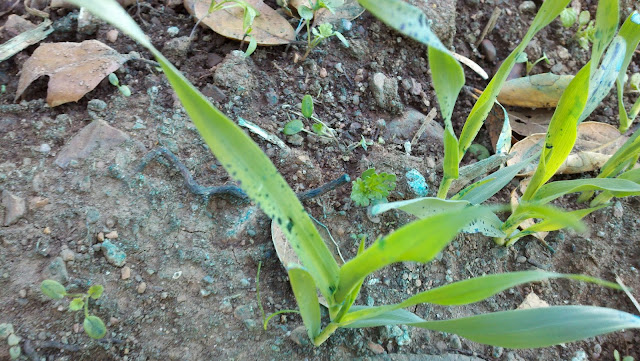
There could be other explanations -- insects can cause a similar disease. Russian Wheat Aphids can cause the same rolled onion-leaf with a trapped grain head, but their infestation also causes laminar discolorations in the plant leaves. I have some discoloration due to aphids, but not in a striped pattern:

Image

and not even every onion-leafed bere plant has that spotty discoloration.

I did find an insect larvae in two of the heads that were trapped in a flag leaf. I pulled out the heads by hand and discovered in each one an insect lodged inside:

Image

I pulled out 2-3 more trapped heads, but I didn't find an insect in any of them.

So what's going on? I don't know, and I'm pretty curious what this could be. I think I can narrow it down to injury from the 2,4-D being applied a little too early, or a strange insect (non-aphid) disease. I'm leaning toward 2,4-D, but one thing I've learned so far about farming is that a newbie can look at a disease phenotype and come to a completely different conclusion than somebody with more experience. So, any ideas?
User avatar
drummstikk
 
Posts: 68
Joined: Thu Feb 18, 2010 2:32 pm

Re: 100% homegrown

Tue Mar 27, 2012 4:14 pm

If you aren't finding the insect in all of the heads, it could be that they were affected by the early herbicide and the insect is taking advantage of the trapped head rather than being the cause..
Spiderwrangler
PFC, Arachnid Deployment Division

In the cellar:
In the fermentor: Belgian Cider
In the works: Wooden Cider
User avatar
spiderwrangler
Global Moderator
 
Posts: 4659
Joined: Thu Jun 03, 2010 2:09 pm
Location: Ohio

Re: 100% homegrown

Fri Mar 30, 2012 12:50 am

spiderwrangler wrote:If you aren't finding the insect in all of the heads, it could be that they were affected by the early herbicide and the insect is taking advantage of the trapped head rather than being the cause..


Good call -- I suspect you're exactly right.
User avatar
drummstikk
 
Posts: 68
Joined: Thu Feb 18, 2010 2:32 pm

PreviousNext

Return to Homegrown

Who is online

Users browsing this forum: No registered users

A BIT ABOUT US

The Brewing Network is a multimedia resource for brewers and beer lovers. Since 2005, we have been the leader in craft beer entertainment and information with live beer radio, podcasts, video, events and more.