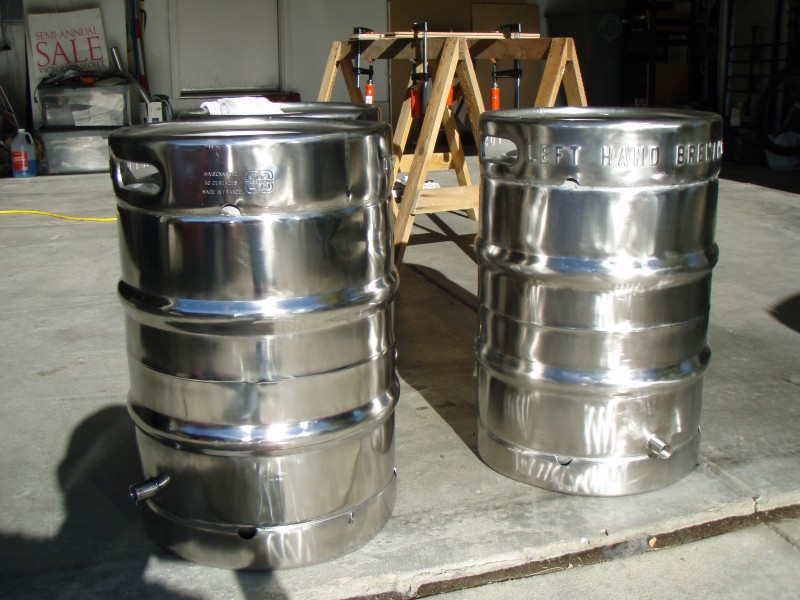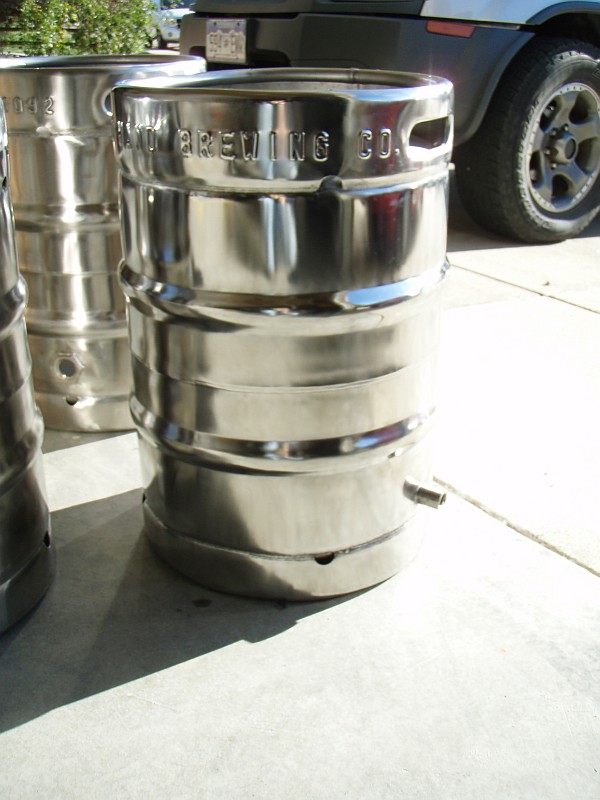
I purchased six used kegs from a local craft brewery (thanks Joe!) and had another that was a reject from a big brewer. All had some damage, generally bent at the Barnes neck, but all still hold liquid. I got a good deal for buying the six together, and figured doing a batch conversion would make things easier and cheaper on a per keg basis, e.g. the welding shop charged me for two hours of work, where one keg wouldn't have been worth their time and they probably would have charged me for an hour.
Big pictures can be found here.
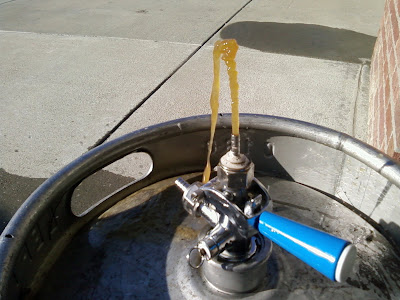
To depressurize the kegs I borrowed a commercial tap from a friend (thanks Kari!) and hooked it up to each. Some still had a bit of beer in them, as I quickly discovered. Lesson learned.
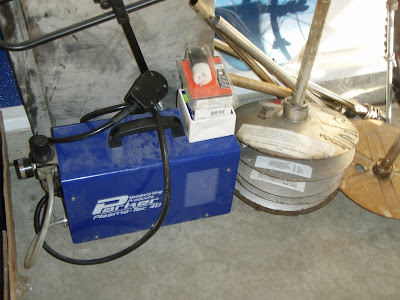
I borrowed a plasma cutter from a friend (thanks Paul!). Since I don't have a 240V line convenient, I enlisted the help of my neighbor (thanks Thomas!), who has 240V to his garage and gas all in one location.
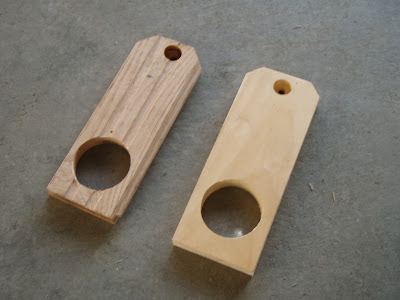
I came up with two different concepts for cutting jigs. One was two pieces of wood with a hinge to go around the curvature at the top of the keg. It turns out that one wouldn't have lasted long, but I'm getting ahead of myself. This is the other concept. One piece of wood with a hole cut out to go around the neck of the keg, and a two step hole for the tip of the plasma cutter. I first made a couple out of pine, with the holes in different locations so I could experiment to get the right diameter hole in the keg top. I wanted it big enough for a false bottom to fit through, but small enough for a commercial pot lid I can buy in town. I figured it was easier to just make a few jigs, draw lines with a pen in the jig, and measure instead of trying to do math.
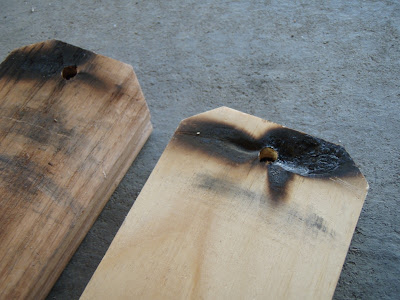
The jig worked, but out of pine the plasma burnt it up quite a bit. One or two kegs and the jig was up. So I made one out of a piece of scrap oak flooring I had. I think we cut at least three kegs with the oak jig and it could still be used for more. My other concept for a jig used 1/4" plywood. That wouldn't have lasted at all. The solid piece worked fine. If I were going to do it again, I'd probably just use the oak jig. It did occur to me that I could replace one piece of wood on the hinged jig with something like a piece of ceramic tile and that could probably be used endlessly.
We filled the kegs with water before cutting to keep the splatter from sticking to the sides. Cutting each keg took about a minute. Most of the time was spent moving the water from keg to keg.
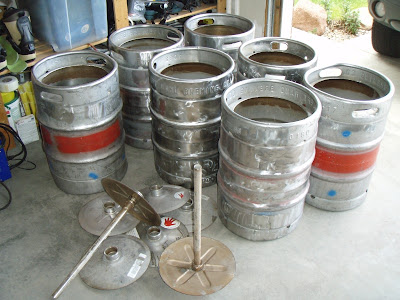
Here they all are after cutting. After this I drilled holes for all the fittings, with a step bit, and I started cleaning up the kegs. Some people have mentioned using a punch for the holes. That might work fine, but I thought the step bits worked fine too. Also, I had different sizes of holes to cut, for 1/4" inch couplings, 1/2" couplings, and a bigger for hex nuts for heating elements. I would have bought three or four different punches, adding up $.
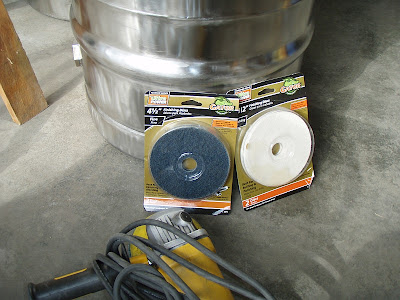
To clean the kegs I started with a coarse rust/paint/scratch removal wheel on an angle grinder. I followed up with a fine finishing pad.
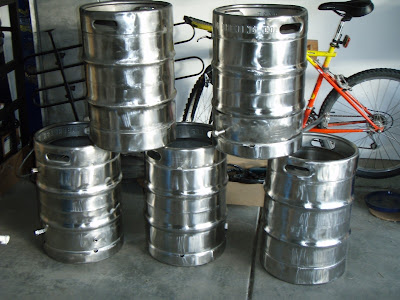
In this photo most of the kegs are done with the blue finishing pad. The top right keg is 2/3 done.
I've sold off a few of the kegs at this point to local homebrewers to cover my costs. For my kegs I'm going to use the cloth pad and polishing compounds to get to a high shine.
More to come ...